
Preparing and maintaining a safe and healthy environment is our highest priority. Whether onboard or ashore, we want everyone to have an extraordinary experience. We take time to plan and train thoroughly and maintain the utmost vigilance to keep everyone as safe and healthy as possible. Communication is key to our ongoing success. Daily check-ins occur between leadership and the staff of each boat to stay on top of the health and well-being of all students. At Sail Caribbean, we sail in fleets. This means that we are together as a team with 2-7 boats including one staff boat. The staff boat is where the Program Director, Fleet Captain, Provisions Manager, and Social Media Mate live. It is also where essential medical supplies stay and where staff meetings take place every night.
Every Sail Caribbean field staff member is certified in Wilderness First Aid and CPR. Additionally, medical officers trained as Emergency Medical Technicians (EMTs) or Wilderness First Responders (WFRs) accompany each program. During our comprehensive 12-day on-site staff training, we review safety procedures specific to our environment and conduct simulated emergency medical drills.

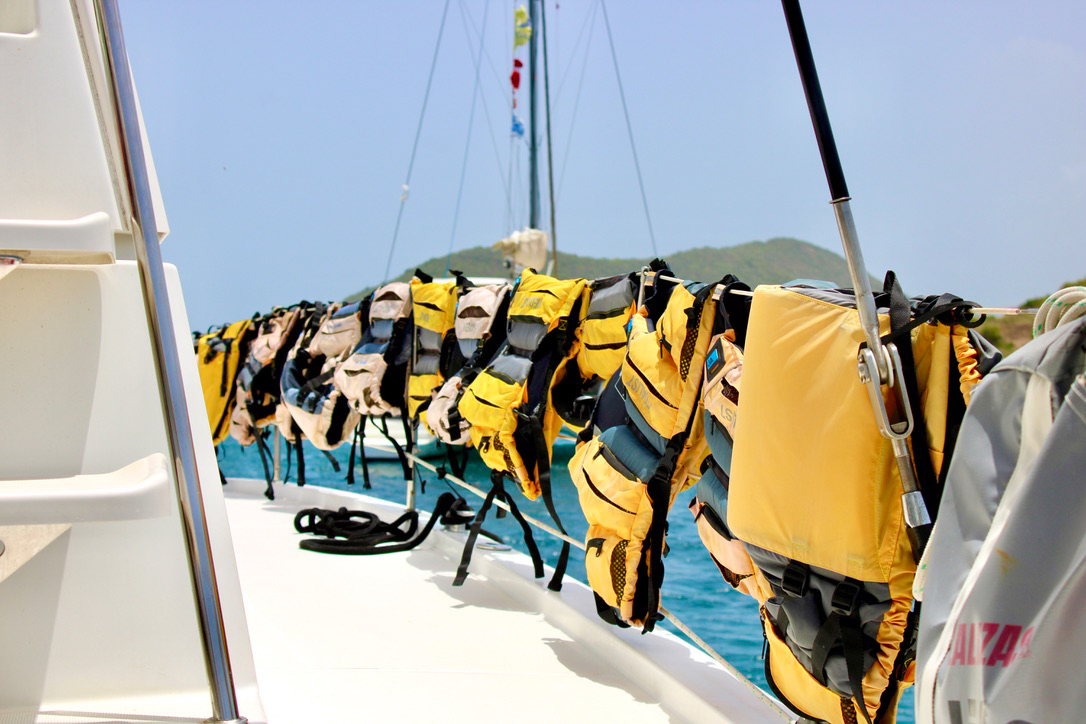
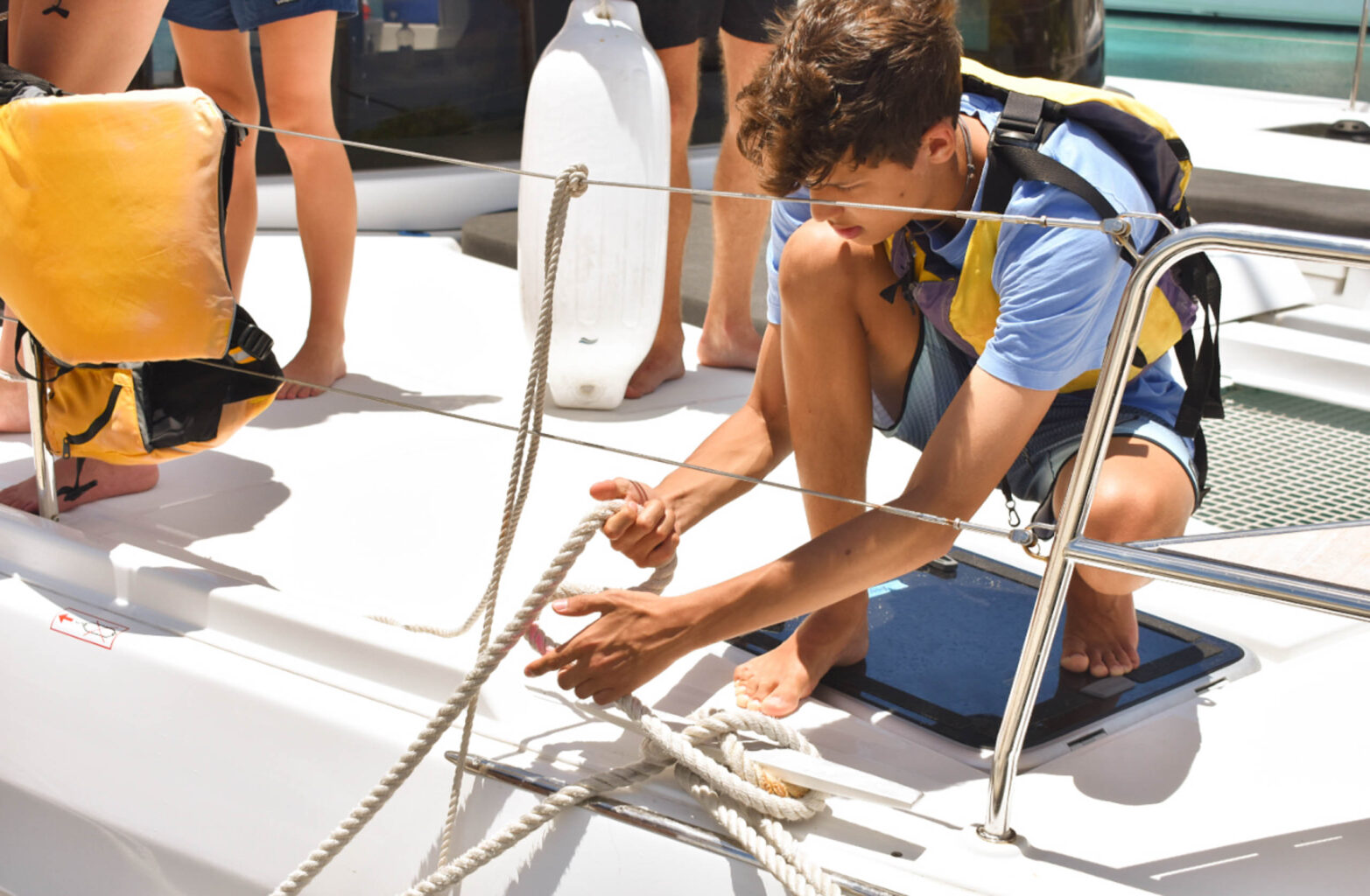
Students, too, are taught the “Safety First” mindset. From day one, we teach students how to be safe both on land and at sea, as well as how to maintain a clean, healthy environment onboard our boats. Lifejackets are worn at all times under sail as well as during our watersports activities. Our staff checks in regularly with students regarding their health and encourages them to speak up about any issues, no matter how small.
If emergency medical attention is required, our high-speed motorboats ensure quick transfer to land, where we have long-term relationships with qualified doctors. We value and trust the local BVI clinics and hospitals that have teamed up with us to provide the best care for our students should the need arise.
Life jackets are worn for all watersports, small boats and even on our 50’ yacht boats while under sail or power. Harnesses are worn during all night sails.
On land, safety continues to be our highest priority. In every case, students are given clear boundaries (and the attractions and highlights within those boundaries so students are not tempted to stray). During daytime excursions, our staff members wear their staff shirts and join the students ashore to provide area supervision throughout the designated areas and particularly at points of interest. Students must travel in buddy groups and check in on a regular basis. During evenings ashore, students and staff are together at all times. The venues are carefully chosen for the student’s enjoyment and with foremost consideration for safety and supervision.
On the boat, there are always at least two, and sometimes three, adults onboard for 10-12 students when the boat is underway. A support staff boat may also accompany our BVI and Leeward Island fleets, providing a “main office” for the Program Director, Fleet Captain, Provisions Manager, and Medical Officer, as well as carrying additional supplies and equipment. These additional staff normally sail with the students each day, rotating through the fleet. Our overall student-to-staff ratio in all programs is 4:1.
Protection from the Caribbean’s strong sun begins with our Packing List, which helps you get ready for your summer trip with Sail Caribbean. We ask you to bring a hat, a lightweight long-sleeved shirt, sunglasses, and sunscreen for sun protection. You may also want to consider bringing a “rash guard” top that can be worn in the water. Additionally, our staff members continually remind students to re-apply sunscreen throughout the day. If a student shows the beginnings of a burn, the captain will place them on “shirt duty”, where they are required to wear clothing to shield them from the sun for as long as necessary. We also emphasize hydration and play games that encourage drinking water during particularly hot weather. The students themselves also share responsibility for these healthy practices, as one of them is in charge of checking in on the crew’s health and safety each day. All of our boats have a bimini (a canvas canopy over the cockpit area) that provides shade while onboard.
Our entire staff undergoes Wilderness First Aid training (WFA)Opens in new tab, a 16-hour program which far exceeds basic first aid training. This specialized training allows them to assess and initiate treatment for injuries and illnesses before seeking professional help. In addition, each program has a dedicated medical officer with an EMT certification, or has completed the more advanced Wilderness First Responder training (WFR)Opens in new tab, an 80-hour certification.